14 February 2008

invited guest: Ami Vitale


Srinagar Kashmir India
Ami Vitale, best known for her cultural documentation has been praised as a humane and empathetic storyteller. She has received recognition for her work from World Press Photo, the NPPA, International Photos of the Year, Photo District News and the South Asian Journalists Association presented her with the Daniel Pearl Award for outstanding print reporting on South Asia.
Hundreds of villagers sit outside their homes after Indian soldiers search for a militant in Budgam district west of Srinagar, March 28, 2002. The militant hid in a mosque in a 20-hour siege. It was the fourth time in two months that separatists had sought refuge in a mosque in the Himalayan region.

Villagers mourn the death of five people who were killed along with 48 who were injured, when a grenade exploded in the hands of a man who was seeking to extort money from a family in Badgam district of Kashmir, March 10, 2004. Locals said the man was a former militant who was extorting money from villagers and thousands came out to mourn the deaths. Tens of thousands of people have died in Kashmir since the eruption of anti-Indian revolt in the region in 1989. Separatists put the toll at...
Her stories have been awarded grants including the first-ever Inge Morath grant by Magnum Photos, The Canon female photojournalist award for her work in Kashmir and the Alexia Foundation for World Peace. Vitale's photographs have been published in major international magazines such as National Geographic, Adventure, Geo, Newsweek, Time, Smithsonian and Le Figaro among others.

A child holds a mushroom in a village in Rwanda in 2004, ten years after the Rwandan genocide when at least 800,000 ethnic Tutsis and thousands of moderate Hutus in Rwanda were killed.
They have also been presented in international exhibitions including: Visa Pour L'Image, Perpignan, France; Reporters Sans Frontiers, Paris; the FotoArt Festival in Poland; the Open Society Institute and The United Nations in New York.

She began her career working as an editor for Associated Press in New York and Washington D.C. and eventually left in 1997 for the Czech Republic where she covered the Balkan conflict. In 2001 she moved to Guinea Bissau in West Africa after she was awarded the Alexia Foundation grant and lived with a tribe of Fulanis in a remote village. When she returned, Vitale moved to India where she lived for over 5 years, producing memorable work throughout the region.

Muslim children sit inside Dariya Khan Ghhumnat Rahat refugee camp set up outside a school in the state of Gujarat in Ahmedabad, India May 10, 2002.

Children who were forced to migrate from their home in Pargwal, India cool off as a truck sprays water on them near Ahknoor in the Indian held state of Jammu and Kashmir. Indian and Pakistani troops continue to exchange heavy mortar, artillery and machine-gun fire along the line that divides Kashmir between them. India is pressing Pakistani President Pervez Musharraf to crack down on the flow of Muslim militants from Pakistan into Kashmir.
Now based in Washington, DC, Vitale is a contract photographer with National Geographic Adventure and National Geographic Magazine and is producing a project for the Nature Conservancy about threatened environments.

Villagers fetch water from a polluted hole in the village of Dambas, 80 kilometers outside of Wajir, in northern Kenya May 10, 2006.

A Kashmiri man paddles to a floating market in the early freezing temperatures before sunrise on Dal Lake in the summer capital of Kashmir, Srinagar India, November 24. In the background, echoing through the nearby mountains, gunshots and fighting could be heard. Kashmir was once a tourist hotspot but now vendors struggle to survive in a place that has seen nearly 1000 civilians killed this year alone and 1,765 wounded in a brutal conflict that the United Nations calls the most dangerous...

more of Ami's works you will find on her web site.
all pictures ©Ami Vitale
Invited by Marcin Górski

listen to a love song

Photographer: Walter Neiger

helper of the chef

"how to photograph the helper of the chef"
Photo: Filipe Franco

Face to face (66)


photographer: Mike Peters

Puck

Photographer: Bengt Björkbom

kitchen


photographer: William Schmidt

Face to Face (65)

photographer: Marcin Górski

Face to Face (64)

photographer: Christo Stankulov

Face to face (63)

Little girl with wounded pigeon
Photographer: Tatiana Bitir

Michi

Photographer: Melanie Neiger
from series "fridges and their owners"

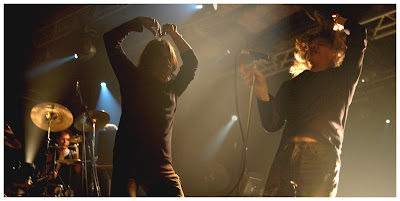
music: el magnifico

the young gods

warszawa/07

13 February 2008

William Schmidt on Kerouac's road: People in places

In 1975, after graduating from college, I set out to discover Kerouac's road. With only my camera as a companion, I travelled through America for three months. I hitchhiked and took Greyhound buses, camped, stayed in hostels and missions and with whomever invited me. It was a great adventure.


William Schimdt's self portrait in the bus.


When I ran out of money, I returned home and had to get a job. I continued to photograph for a while, but eventually put my camera away. The photographs and negatives were put into a box and stored at my mother's house. When she moved twenty-five years later, she threw the box away. All that remains are some fading proof sheets which I have scanned. Everything else is gone but the memories.


The photos fascinate me for a number of reasons. They seem ironic now, both intimate and distant. Though the quality of the images is marred, their subjects and subjectivity present what Maria Kroenenberg calls "a vision felt", an "illustration of mood." Life's great paradox is that one both becomes in and is destroyed by time. In time's twisted logic, gaining is losing. We are, by and large, who we remember ourselves to be, but memory is infamously unreliable.


My memory of what occurred when I made these pictures has been shaped by the events that have followed. I may only recall, not retreat into this past. Like these photographs, the memories of that time are veiled, mysterious, and, perhaps, even beginning to attain the semblance of myth. "I was there," I tell myself. There is evidence. The photos represent a time of innocence and exist now only in cyberspace, a series of zeros and ones, intangible but sensible, an X-Ray of a spirit.


Bachelard says that we remember people in places. When we see faces we can't recall, we say that we can't place them. Here are some portraits I made on that trip. People in places.


F blog was honoured by William and offered possibility of showing his unique, personal, historical already pictures. Thank you William, this is very special for us.
We will show William Schmidt's works in several posts.
Stay tune/Marcin

More of William's works you may find on his blog.

kiosk in front of church

Photographer: Christo Stankulov

Mother and grandmother in the kitchen


Photographer: Christo Stankulov

spinach

Photographer: Emese Altnöder

Kitchen - a mini project

Photographer: Malin Michelsen


Unidentified shelf of kitchen utensils and jars of spices
CREATED/PUBLISHED [between 1941 and 1945]
Library of Congress, Prints & Photographs Division,
FSA-OWI Collection, [reproduction number, LC-USW361-953]


Photographer: Markus Jenemark

This mini project is dedicated to la cocina, köket, the kitchen. A kitchen is according to wiki: "a room or part of a room used for food preparation including cooking, and sometimes also for eating and entertaining guests, if the kitchen is large enough and designed to be used that way."

We want your interpretation of every aspect of this subject: details, people having breakfast or cooking dinner, mobile kitchens, restaurant kitchens, Japanese kitchens, Chiapas kitchens, Polish kitchens...you name it! As usual, we rely on your imagination dear reader of the F blog. Please send your contributions to the gruppo F inbox address.

Three projects will be featured all of 2008: Face to face, Trees and DOCU-08. We hope to be able to make an online exhibition (or even a real life exhibition) with photos from these projects in the beginning of 2009.

So, stay tuned to F - the Photogenic channel.

late night music

Photographer: Walter Neiger

12 February 2008

Face to face (61)

La Habana
Photographer: Francisco Mata Rosas

People of Praga

Portraits of the homeless who live in shelters built by themselves on the Warsaw's right bank of the Vistula river.


date: 01.08
place: Warsaw-Praga, Poland
photographer: Maciek Pisuk
Pictures from ongoing series, parts of this series were already presented in the F blog, you may find it here and here.

Face to Face (60)


photographer: Emmanuel Smague

11 February 2008

invited guest: Francisco Mata Rosas


CENTRO HABANA
The economic embargo imposed by the United States, the erosion of the political system, the period of economic hardship in which Cubans have been living in for over 10 years, and recently the presence of tourists, particularly those looking to find cheap sex, defines the context in which Cuban people are growing up; the third post-revolution generation is growing up in the period of economic hardship, without understanding the reasons behind their predicament, as the world looks on, as if observing a vast social experiment to see how long Fidel's system can survive, without caring that human beings are spending their youth and childhood in these difficult conditions.


The lack of available goods, disenchantment, tradition, hopes, distortion of the concept of work due to the easy money that tourism represents, confused ideas about information, music, baseball, the sea as an unbreakable border, sex as a means of finding an economic future, are all part of this large universe where Cubans are growing up today. On the other hand, independently of these political, social and economic conditions, the Cuban culture is alive, preserving its traditions particularly in sports, music, and the arts which express themselves vividly.


I try to understand this context and to photograph these Cubans and their daily lives, these children who will become the political leaders, baseball players, doctors, musicians, athletes, prostitutes and artists of the next Cuban century - these children who are in fact the unknown dimension of this island, of this system, this third and fourth generation of hopes.


Francisco Mata Rosas
Born in Mexico City in 1958, he has lived there ever since. He has a B.A. in Communications Science from the Universidad Autónoma Metropolitana, Xochimilco campus. He was a photojournalist for La Jornada newspaper for six years after its creation. His photographic works have been published in some of the main newspapers and magazines in the United States, Spain, Canada, Italy, England, and Mexico. There have recently been exhibits of his photographs in Mexico, Holland, Germany, Italy, Spain, France, England, the United States, Scotland, Japan, Argentina, Brazil, Panama, Uruguay, Ecuador, Peru, Honduras, Cuba, Ukraine, Bratislava, South Africa, China and Costa Rica, to mention just a few.

Mata has also received the following awards, among others:

•Acquisition award of the Mexican Photography Biennal, 1988
•Honors at the Bicentennial of the French Revolution Con-test, 1989
•Young Creators' Grant from the National Fund for Culture and the Arts (FONCA), 1989
•Third Annual Mother Jones, USA, 1993
•FONCA Coinvestment Award, 1994
•First International Award for Internet in Japan, 1997
•FONCA Promotional Award, 1999
•He has been a member of the National System of Art Creators in México since 2000

In the editorial field, his pictures can be found in over twenty books and he is the individual author of Sábado de Gloria (Easter Saturday), 1994, América profunda (Deep America), 1999, and Litorales (Coasts), 2000, Mexico Tenochtitlan, 2005 and Tepito ¡bravo el barrio!, 2007. He has also participated as lecturer in most of the photographic events in Mexico, has been a judge of several national and international contests, and has given talks and courses over the past ten years in various universities and cultural centres in the country and abroad.

His official website is: www.franciscomata.com.mx

invited by ulf fågelhammar
all pictures and text ©Francisco Mata Rosas